How to Read a Humic Acid Certificate of Analysis (COA) Like an Expert
 Oct 15, 2026|
 View:25
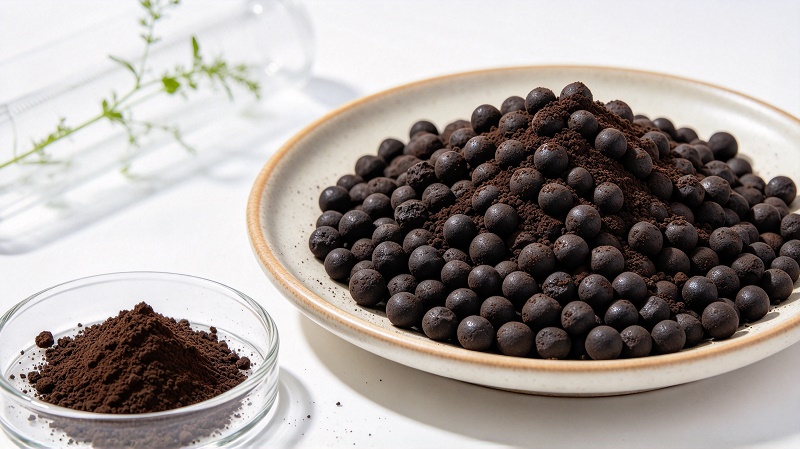
A Certificate of Analysis is not just a piece of paper—it's your best defense against buying low-quality humic acid.
When you're sourcing humic acid in bulk, the COA is the single most important document you'll receive from a supplier. It tells you exactly what's in the product, how it was tested, and whether it meets your quality standards. But here's the problem: most buyers glance at the "humic acid content" number, nod approvingly, and move on. That's a costly mistake.
This guide will teach you how to read a humic acid COA like a procurement professional—so you can spot red flags, ask the right questions, and confidently choose a supplier you can trust.
Key Takeaways
A humic acid COA must specify the test method for each parameter—without it, the number is meaningless.
Humic acid content should always be reported on a dry basis and verified by an independent laboratory.
Solubility claims like "100% soluble" mean nothing without defined conditions (water temperature, hardness, concentration).
Heavy metal limits (arsenic, cadmium, lead, mercury) are non-negotiable for organic certification and food-grade applications.
Ash content, moisture, and pH reveal the true purity and practical behavior of the product.
A trustworthy supplier provides batch-specific COAs and welcomes third-party verification.
Chapter 1: What Exactly Is a Humic Acid COA?
1.1 The Purpose of a COA
A Certificate of Analysis is a formal document issued by a manufacturer or an independent laboratory that reports the test results for a specific batch of product. For humic acid, it serves three critical functions:
Verification – Confirms that the product meets the specifications stated on the label or contract.
Traceability – Links the results to a specific production batch and lot number.
Compliance – Provides the data needed for regulatory filings, organic certification, and quality audits.
A COA is not a marketing brochure. It is a technical document that should contain precise, measurable values—not vague claims.
1.2 COA vs. Specification Sheet
Many suppliers send a "spec sheet" and call it a COA. These are not the same thing.
| Document Type | What It Shows | What It Doesn't Show |
|---|---|---|
| Specification Sheet | Target ranges the product is designed to meet | Actual test results for a specific batch |
| Certificate of Analysis | Real test results for a specific batch, with methods | Future production guarantees |
Always request a batch-specific COA—not a generic spec sheet—before making a purchase decision.
Chapter 2: The Critical Parameters You Must Check
2.1 Humic Acid Content (and Why the Method Matters)
This is the headline number everyone looks at. But the number alone is useless without context.
What to check:
Basis: Is the result reported on a dry basis or as-is? Dry basis is the industry standard because it removes the effect of moisture. A product claiming "70% humic acid" on an as-is basis might only contain 60% on a dry basis.
Test method: Common methods include the CDFA method, ISO 19822, and UV-Vis spectrophotometry. Each method can yield different results. A COA that doesn't state the method is incomplete.
Independent verification: Was the test performed by an in-house lab or an independent third-party lab? For bulk purchases, independent verification (e.g., SGS, BV) carries far more weight.
Red flag: A COA that reports humic acid content without specifying the test method or basis.
2.2 Solubility: Don't Accept "100% Soluble" Without Conditions
Solubility is the most practical quality indicator—and the most commonly exaggerated claim on a COA.
A properly documented solubility test should specify:
Dosage: Grams per liter or final tank concentration
Water temperature: Cold water solubility is very different from warm water solubility
Water hardness and EC: Hard water can dramatically reduce solubility
Mixing time: How long was the sample agitated?
Insoluble residue: What mesh or filter was used to capture undissolved particles?
Sediment after 2h, 24h, and 48h: Does the solution remain stable over time?
For potassium humate powders, a product that dissolves perfectly in soft, warm water may fail completely in hard, cold water or when blended with acidic fertilizers.
Red flag: A COA that simply states "100% soluble" without defining the test conditions.
2.3 Potassium Content (K₂O vs. K)
Many humic acid products are produced as potassium salts. The COA may report potassium as either elemental K or K₂O equivalent—and these are not the same number.
A practical conversion: K₂O = K × 1.205. If a COA reports 10% K and you need to compare it to a competitor's K₂O value, multiply by 1.205 to get 12.05% K₂O.
Important: High potassium content does not automatically mean high-quality humic acid. Potassium is used to neutralize the humic acid during extraction—it's a processing aid, not the active ingredient. For OMRI-listed products, the humic acid content must be at least 1.5 times the KOH level used in extraction.
2.4 Heavy Metals: The Non-Negotiable Safety Check
Heavy metal content is a critical safety parameter, especially for products intended for organic farming or food-grade applications.
The COA should report results for:
| Heavy Metal | Typical OMRI/Organic Limit |
|---|---|
| Arsenic (As) | ≤ 13 mg/kg |
| Cadmium (Cd) | ≤ 3 mg/kg |
| Chromium (Cr) | ≤ 210 mg/kg |
| Lead (Pb) | ≤ 150 mg/kg |
| Mercury (Hg) | ≤ 1 mg/kg |
These limits are based on the Canada Organic Regime standards used by OMRI for reviewing humic acid products.
What to look for: The COA should specify the test method (typically ICP-MS or ICP-AES) and the detection limit. Results reported as "less than" a detection limit are acceptable; results that simply say "none detected" without a method are not.
2.5 Ash Content and Moisture
Ash content tells you how much inorganic (non-humic) material is in the product. For high-quality humic acid, ash should typically be below 15–20%. Elevated ash suggests contamination with soil, sand, or other mineral matter.
Moisture content affects the actual humic acid content you're getting per kilogram of product. A product with 15% moisture contains significantly less active humic acid per ton than one with 8% moisture. Always compare products on a dry basis.
2.6 pH Value
The pH of a humic acid product affects its compatibility with other inputs and its behavior in soil. Most high-quality potassium humate products have a pH between 9.0 and 11.0 in solution. Products with extremely high or low pH may cause issues when blended with fertilizers or applied to sensitive crops.
Chapter 3: Parameters at a Glance
| Parameter | What It Tells You | Ideal Range | Red Flag |
|---|---|---|---|
| Humic Acid Content | Active ingredient concentration | 50–70%+ (dry basis) | No method stated |
| Solubility | Practical usability in irrigation | ≥ 95% in defined conditions | "100% soluble" without conditions |
| K₂O Content | Processing indicator, not quality marker | 5–12% (varies by grade) | K₂O exceeds HA content |
| Heavy Metals | Safety and compliance | Below OMRI limits | No method or detection limit |
| Ash Content | Inorganic contamination | ≤ 15% | > 20% |
| Moisture | Net active content per ton | ≤ 10% | > 15% |
| pH | Compatibility with other inputs | 9.0–11.0 (solution) | Extreme values without explanation |
Chapter 4: How to Verify a COA Before You Buy
4.1 Check the Basics
Before diving into the technical data, verify that the COA contains:
Product name and grade
Batch or lot number (must match the product you're receiving)
Date of manufacture and expiry
Name and address of the testing laboratory
Signature or stamp from an authorized person
A COA missing any of these elements should be questioned.
4.2 Ask These Five Questions
"Was this tested by an independent laboratory?" In-house results are a starting point, but independent verification is the gold standard.
"What method was used for humic acid content?" If the supplier can't answer this, they may not understand their own product.
"Can you provide a solubility test report with defined conditions?" This separates serious suppliers from traders.
"Is the humic acid content reported on a dry basis?" This ensures fair comparison between products.
"Can I see a COA for the exact batch I'll receive?" Batch-specific documentation is essential for traceability.
4.3 Cross-Check with Certifications
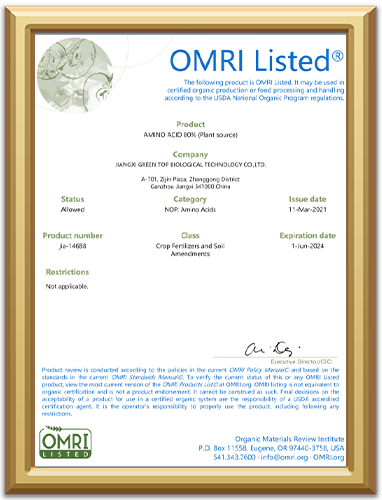
If a supplier claims OMRI listing, verify it independently. The OMRI Products List is searchable online, and the product name on the COA must match the listing exactly. A product may be OMRI-listed for one use class but not another—check the specific category and restrictions.
Chapter 5: Frequently Asked Questions (FAQ)
A: There is no single "most important" number. Humic acid content matters, but it must be evaluated alongside solubility, heavy metals, ash, and moisture. A product with 70% humic acid that doesn't dissolve is useless in fertigation.
A: Different test methods (CDFA, ISO, UV-Vis) can yield different results. Also, results may be reported on a dry basis or as-is. Always compare COAs that use the same method and basis.
A: Not necessarily. A 70% product with poor solubility may perform worse than a 60% product with excellent solubility and low ash. Practical performance depends on the full profile, not just one number.
A: For every new batch you receive. Quality can vary between batches, especially with natural raw materials like leonardite. A supplier who cannot provide batch-specific COAs is a supply risk.
A: For organic applications, the OMRI/COR limits are a good benchmark: arsenic ≤ 13 mg/kg, cadmium ≤ 3 mg/kg, chromium ≤ 210 mg/kg, lead ≤ 150 mg/kg, and mercury ≤ 1 mg/kg.
A: Yes—if it's from a reputable manufacturer with independent third-party testing. Major international labs like SGS and BV operate in China and provide verifiable reports. The key is to request independent testing, not just in-house results.
Conclusion: Read the COA, Protect Your Investment
A humic acid COA is more than a compliance document—it's a window into the quality, safety, and reliability of the product you're buying. By understanding the key parameters, asking the right questions, and insisting on independent verification, you can avoid costly mistakes and ensure your soil amendment program delivers the results you expect.
Choose GreenTop for Transparent, Verified Humic Acid
GreenTop (Jiangxi Green Top Biological Technology Co., Ltd.) has been a leading manufacturer and supplier of humic acid and related products for over 15 years. Headquartered in Ganzhou, Jiangxi Province, we source our raw materials from premium leonardite and lignite deposits in Shanxi, Xinjiang, and Ningxia.
Every batch of our humic acid products is backed by:
Independent third-party testing (SGS, BV) with full method documentation
Batch-specific COAs available upon request
OMRI-listed products for organic operations
Consistent specifications across powder, flake, granule, and crystal forms
Whether you're a fertilizer manufacturer, a government project contractor, or a bulk commodity trader, GreenTop provides the documentation, transparency, and supply chain reliability you need to make confident purchasing decisions.
Contact GreenTop today to request a sample COA, discuss your specifications, or receive a customized quote for your humic acid requirements.